
Allergy Safety in Schools: What the New Statutory Guidance Actually Means for Your School
A practical breakdown of the DofE’s 2026 statutory guidance (Benedict's Law)
In a rush? Here are the key takeaways if you don’t want to scroll:
From September 2026, all LA-maintained schools, academies and PRUs in England must have an allergy safety policy in place and must have regard to the DfE's statutory guidance.
Independent schools and non-maintained special schools follow later, also expected New Year 2027.
Schools must appoint a named senior leader responsible for allergy safety — it can't sit with the catering manager.
The guidance sets a strong expectation that schools stock spare adrenaline auto-injectors (AAIs), in pairs, matched to correct dosage, reachable within five minutes.
First aid training alone isn't sufficient — all staff present when pupils are on site need dedicated allergy awareness training, refreshed annually.
Every pupil with a functional-impact allergy needs an Individual Healthcare Plan (IHP) — a school-owned document, distinct from and referencing (not rewriting) any clinical Allergy Action Plan.
The guidance explicitly advises against "nut-free" policies in favour of a broader "allergy aware" environment.
The story behind Benedict's Law
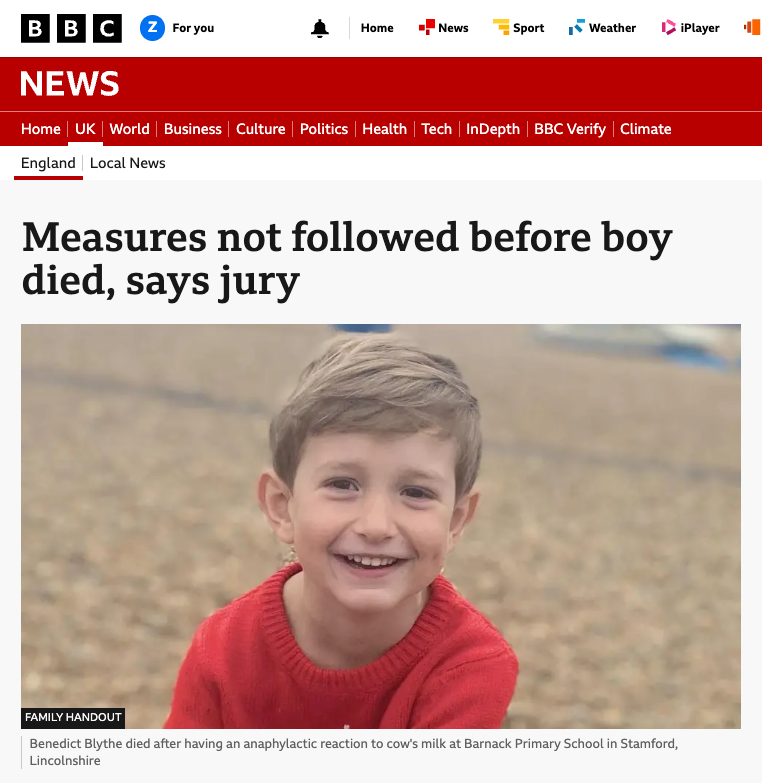
Benedict's Law is the informal name for section 34 of the Children's Wellbeing and Schools Act 2026, named after five-year-old Benedict Blythe.
On 1 December 2021, five-year-old Benedict Blythe collapsed at Barnack Primary School near Stamford, Lincolnshire, and was pronounced dead in hospital that afternoon.
Benedict had asthma and severe allergies to milk, eggs, kiwi and certain nuts. His parents had worked with the school to put a specific safety process in place: his oat milk was to be kept, labelled, in the staff fridge, poured into his own cup in the classroom, and handed directly to him.
An inquest jury later found that on the day he died, that process wasn't followed - his milk was poured in the staff room and carried through to the classroom instead. The jury concluded Benedict had probably been exposed to cow's milk protein, most likely from his own drinking bottle, and identified several contributing failures: a delay in administering his adrenaline, opportunities for cross-contamination between his milk and other pupils', and the fact that his allergy action plan hadn't been shared with all the staff who needed to know about it.
Benedict's mother, Helen Blythe, described his death as "preventable" and "caused by a cascade of failures - individual, institutional, and systemic." She went on to found the Benedict Blythe Foundation, which has since documented wider, systemic gaps in how schools across England manage allergy risk, and campaigned - alongside local MP Alicia Kearns - for a change in the law.
That campaign is the direct origin of Benedict's Law: section 34 of the Children's Wellbeing and Schools Act 2026, and the statutory guidance it triggered. Every requirement covered below - named senior leaders, mandatory training, spare adrenaline devices, properly shared Individual Healthcare Plans - traces back to specific, identifiable failures in Benedict's case. Understanding that context matters, because it reframes this guidance from a compliance exercise into what it actually is: a direct response to how a five-year-old died at school in a way his family and an inquest jury concluded was preventable.
What the update to the guidance actually requires
In July 2026, the Department for Education published Allergy Safety in Schools, the statutory guidance that governing bodies, academy trusts and PRUs must now have regard to when meeting their duties under Benedict's Law - formally, section 34 of the Children's Wellbeing and Schools Act 2026, which amends section 100 of the Children and Families Act 2014.
This is the single most important document school leaders need to read before September. It's long, dense, and written in DfE legal prose. So we've broken it down into what actually matters operationally: who it applies to, what your allergy safety policy must cover, how spare adrenaline devices should be stocked and stored, what an Individual Healthcare Plan needs to contain, and how to handle serious incidents when they happen.
We'll flag clearly, throughout, what is a hard statutory duty today versus what the Government intends to introduce through forthcoming regulations - because the distinction matters for how urgently you need to act.

The passing of Benedict's Law was a long and arduous process that required multiple levels of government action, led by Helen Blythe, who lost her son Benedict in a tragic, severe allergic reaction.
Who Benedict’s Law applies to
Section 100 of the Children and Families Act 2014 already required schools to support pupils with medical conditions. Section 34 of the Children's Wellbeing and Schools Act 2026 adds a specific, standalone requirement: schools must now have a dedicated allergy safety policy, publish it, and keep it under review.
Crucially, this guidance only covers the allergy safety duty introduced by section 34. It sits alongside - not instead of - the existing Supporting pupils with medical conditions at school guidance, and it doesn't create any new framework for delegating clinical healthcare tasks to school staff. Where a pupil's needs require genuine healthcare activity, that still has to run through proper NHS clinical governance, training and accountability arrangements.
It's also worth understanding what "having regard to" statutory guidance actually means: schools must take it into account and give it genuine, careful consideration. They're not legally barred from departing from it, but if they do, they need a clear and justifiable reason for doing so. In practice, for a compliance-sensitive area like this, departing from the guidance without very good cause is a risk most schools shouldn't take.
The statutory duty currently sits with:
Governing bodies of maintained schools (including special schools, but not maintained nursery schools)
Proprietors of academies, including free schools and alternative provision academies
Management committees of pupil referral units (PRUs)
Independent schools and non-maintained special schools aren't yet under a statutory duty - but the Act requires the Government to bring in equivalent requirements through the Independent School Standards and Non-Maintained Special School Regulations, so this is a "when," not an "if." Early years settings and FE colleges aren't in direct scope either, though the guidance is explicitly intended to be useful to them, and good practice for early years providers should already be shaped by the EYFS framework.
If you're a MAT, note that the trust holds the legal responsibility as the governing body - but each individual academy should have its own named allergy safety lead responsible for implementing the policy locally, with oversight arrangements set out clearly in the scheme of delegation.

Most schools and multi-academy trusts across England are expected to follow the guidance by September 2026
What your allergy safety policy needs to cover
The guidance sets out, in detail, the areas an allergy safety policy is expected to address. Broadly, they fall into three groups:
Culture-level policies:
Allergy awareness training for staff
Wellbeing support and anti-bullying measures for pupils with allergy
Minimising exposure to known allergens across the school environment
Food allergy management and allergen information
Individual pupil arrangements:
How pupils, staff and visitors with allergy are identified
Individual Healthcare Plans (IHPs)
Access to prescribed adrenaline devices
School-wide operational policies:
Stocking, storing and using spare adrenaline devices
Visits and trips
Recording and reporting serious incidents and near misses
Information sharing
How the policy itself is communicated and published
A template allergy safety policy is available via gov.uk, and the guidance strongly recommends reviewing your policy at least annually - more often if incidents or near misses point to gaps. Policies should be developed with input from pupils, staff and parents who are themselves affected by allergy, not written in isolation by the senior leadership team.
Our CPD-accredited allergy and anaphylaxis training course at Kitt Medical is mapped directly against the statutory guidance's expected training outcomes, split into schools and workplace pathways.
One point worth building into your review cycle: allergy safety drills. The guidance treats these the same way as fire drills - a simulated anaphylaxis scenario, tested without any risk to a real pupil, with results logged and fed back into the policy review process.
Also - Every school needs a named member of the senior leadership team responsible for allergy safety - driving the policy's implementation and leading its review. This can't be left with the catering manager. A named governor isn't currently mandatory, though many schools appoint one as good practice. The Government has signalled it intends to make the named senior leader role a statutory requirement through forthcoming regulations, so treat this as settled rather than optional.

Schools need to become allergy-safe environments across all the areas of their site, from classrooms to canteens, sports halls to playgrounds, and even be mindful of off-site trips.
Individual Healthcare Plans (IHPs): what they are and aren't
This is one of the most misunderstood parts of medical conditions policy, and the guidance is unusually clear about it: an IHP is not a clinical document.
A pupil needs an IHP if their allergy has a functional impact on them at school, poses a risk of harm, and requires support that's additional to or different from what's offered generally. The IHP itself is the school's own description of how it will respond to the clinical advice it has received - not a substitute for that advice. Any Allergy Action Plan, Asthma Action Plan or care plan issued by a healthcare professional should be attached to the IHP, not rewritten or summarised into it, precisely because rewriting clinical instructions risks introducing errors.
The guidance gives a useful worked distinction: a pupil with a severe nut allergy and a history of anaphylaxis clearly needs an IHP referencing their Allergy Action Plan and prescribed adrenaline. A pupil with mild hay fever who can safely self-administer over-the-counter antihistamine under the school's general medical conditions policy may not need one at all. The test is functional impact and risk, not diagnosis on paper - a pupil doesn't need a formal diagnosis to warrant an IHP if their symptoms and risk profile justify one.
IHPs should be reviewed at least annually, and immediately after any serious incident, near miss, or change in clinical advice. When a pupil moves school, their IHP doesn't transfer directly - the new school draws up its own, informed by the old one.
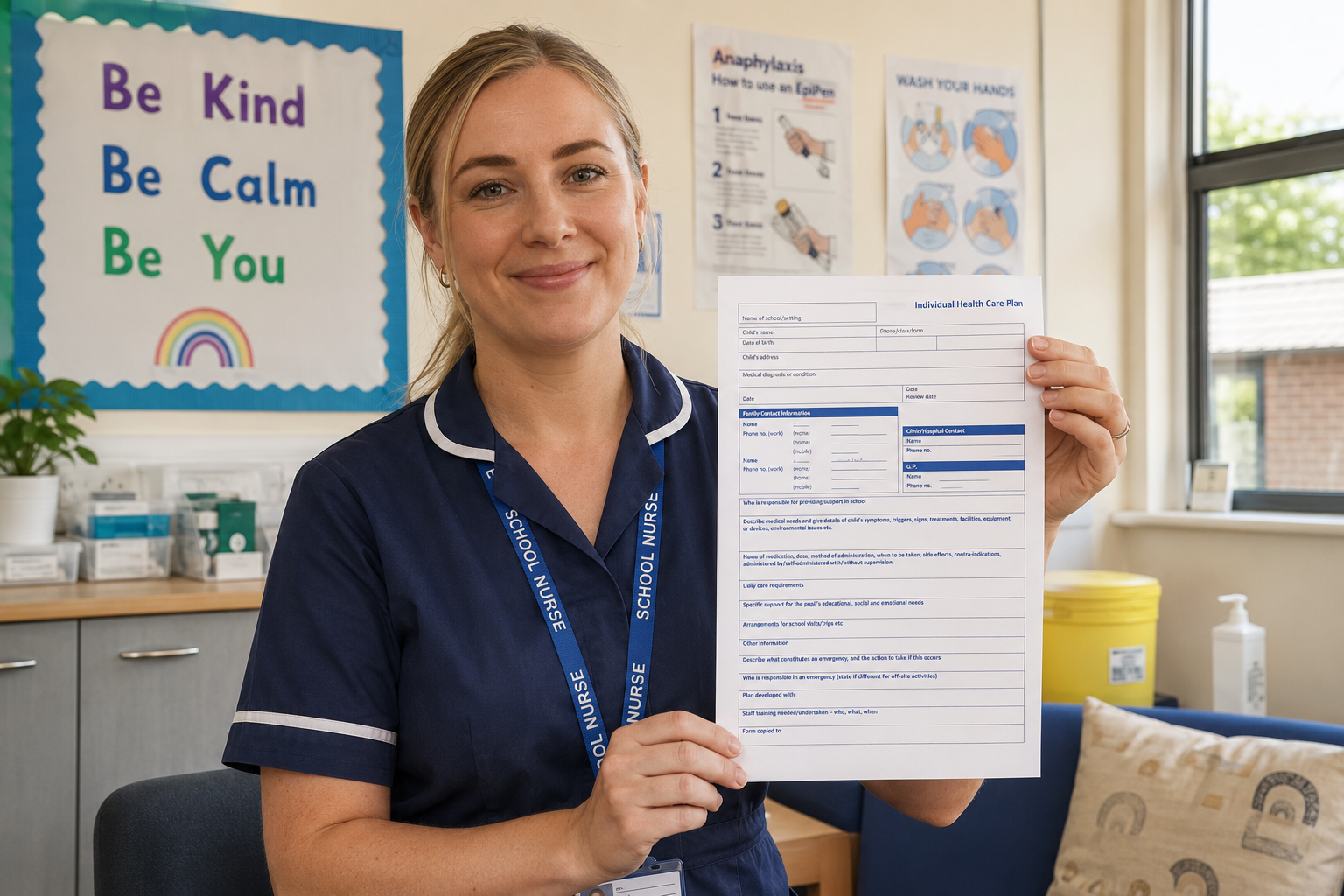
Every pupil with a known allergy should have an Individual Healthcare Plan (IHP) put in place that references their Allergy Action Plan.
Staff allergy training: what needs to be included
This is one of the areas where the guidance gets specific, and where many schools will find their current provision falls short. First aid training on its own is explicitly not considered sufficient.
Every staff member who is present when pupils are on site - permanent staff, supply teachers, peripatetic staff, agency workers, regular volunteers, and catering staff - needs allergy awareness training, refreshed at least annually. The guidance lists what that training should actually achieve, including that staff can:
Recognise the range of symptoms of an allergic reaction and distinguish them from anaphylaxis specifically
Understand the difference between food allergy, coeliac disease and food intolerance
Know how to locate and administer emergency medication - both a pupil's own prescribed device and the school's spare adrenaline devices
Understand the school's allergy safety policy and how to check whether a pupil has a known allergy or an Allergy or Asthma Action Plan
Know how to report an incident or near miss
New staff need this as part of induction, and cover or supply staff need it too - which means your onboarding process, not just your annual CPD calendar, needs to build this in.

Training should be completed by all school staff and can be done either in person or online - being specific to the Benedict's Law requirements and not just first aid.
Spare adrenaline devices: how and what to have in case of emergency
This is the part of the guidance with the most concrete compliance requirements, because it maps directly onto a legal permission created back in 2017.
The Human Medicines (Amendment) Regulations 2017 allow schools - but not early years settings or FE colleges - to buy spare adrenaline auto-injectors (AAIs) without a prescription, for emergency use. The guidance states plainly that the Government expects all schools to stock spare AAIs, and signals a forthcoming statutory duty to that effect.
Key operational rules:
Spare AAIs must be stocked in pairs, of the correct dosage for the pupil population (150mcg for under-6s, 300mcg for over-6s)
They must be readily accessible - not locked away, not kept in a restricted office
In an anaphylaxis emergency, a device needs to reach the affected pupil within five minutes, which for larger secondary schools may mean two sets of spare devices located across the site
They must be stored at room temperature, never refrigerated or left in direct sun
Clearly labelled as "spare" and kept separate from any pupil's individually prescribed device
Only AAIs can currently be stocked as spare devices - non-injectable nasal adrenaline sprays cannot be purchased as spares under current regulations, even though they can be individually prescribed. If a pupil prescribed nasal adrenaline has a reaction and their own device isn't available, the school's spare AAI is used instead.
The guidance is also unambiguous on the legal position around consent: the 2017 regulations don't require prior consent for spare adrenaline to be used in a genuine emergency. Getting advance parental consent is good practice - but a member of staff acting in good faith to save a life is protected regardless.
For the DfE and MHRA's own technical guidance on sourcing and storing spare devices, see Using emergency adrenaline auto-injectors in schools and the BSACI's spare adrenaline in schools resource hub, developed with DHSC, DfE and the National Allergy Strategy Group.
Our wall-mounted Anaphylaxis Kitts with expiry tracking at Kitt Medical are built around exactly this dosage, pairing and accessibility standard, so schools don't have to manage stock rotation manually.
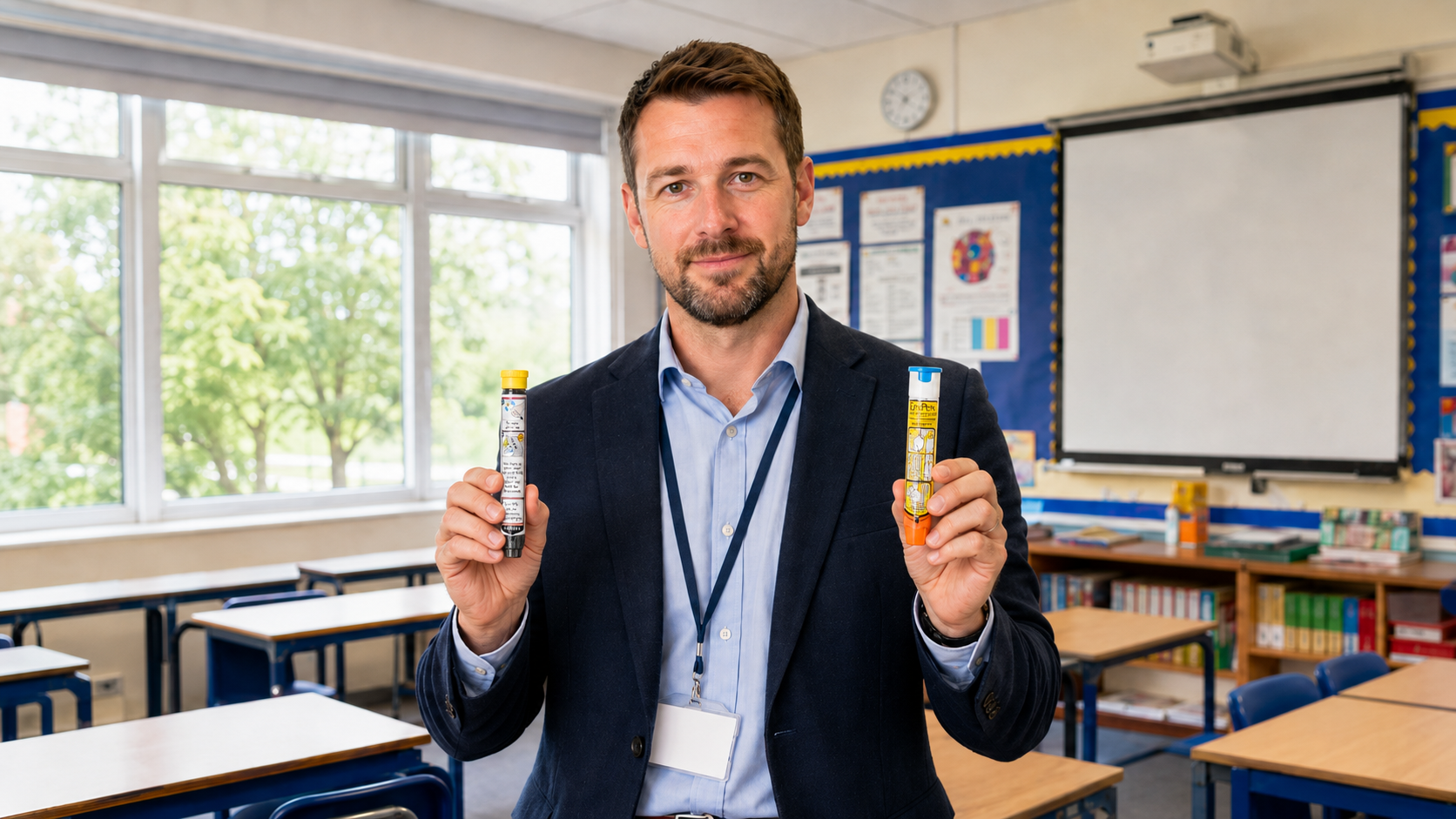
Adrenaline pens are currently available in two different brands in the UK: Jext and EpiPen. Spare adrenaline devices should be installed in schools in pairs, accessible within five minutes of a potential emergency.
Recognising and responding to anaphylaxis
The guidance sets out the ABC framework that underpins the whole document:
A – Airway: throat or tongue swelling, tightening in the throat, hoarse voice, difficulty swallowing
B – Breathing: sudden wheezing, persistent cough, noisy or difficult breathing
C – Circulation: dizziness, sudden sleepiness or confusion, pale clammy skin, loss of consciousness
If any one of these signs is present, the guidance is direct: don't delay. Lie the individual flat with legs raised (unless breathing difficulty means they need to sit), give the adrenaline device without delay, and dial 999 immediately - stating "anaphylaxis" clearly to the operator. A second dose should be given after five minutes if there's no improvement and a second device is available.
Help must go to the pupil, not the other way round. A pupil experiencing anaphylaxis should never be sent to a school office or medical room unaccompanied - that's listed explicitly as unacceptable practice. Movement can worsen the symptoms of a severe allergic reaction.
The guidance also draws a clinically important point out of the National Child Mortality Database's findings: anaphylaxis fatalities in schools are strongly linked to delay in administering adrenaline, and to reactions being misread as "just" an asthma attack in pupils who have both conditions. If a pupil with known food allergy and asthma has sudden breathing difficulty, the guidance is clear that giving adrenaline first is safe and may be life-saving - reliever inhalers should never be given instead of adrenaline to treat suspected anaphylaxis.
For patient-facing symptom guidance you can safely link parents to, see the NHS page on anaphylaxis and Anaphylaxis UK's emergency treatment guidance.

The symptoms of anaphylaxis often directly affect the airways and blood circulation, causing difficulty in breathing and potential collapse. Notably, they are much more severe than the itchiness and swelling that might be present in a mild allergic reaction.
Food allergy and school meal provision
Most food allergic reactions are caused by 14 recognised allergens, but the guidance is explicit that a "nut-free school" policy is not the recommended approach - it creates a false sense of security given how many other allergens exist and how confusing "may contain" labelling can be for staff and caterers to police. The recommended framing is an "allergy aware" environment rather than a blanket ban on individual foods.
Statutory obligations that intersect with allergy safety policy include:
The Food Information Regulations 2014, requiring caterers to declare the 14 regulated allergens
Natasha's Law (the 2021 amendment), requiring full ingredient labelling on any food pre-packed for direct sale
The duty to notify the local authority where unsafe food - including food with an undeclared allergen - has left the school's immediate control and poses a wider risk, under Article 19 of Regulation (EC) 178/2002
Schools acting as food businesses (which covers on-site catering and breakfast/after-school clubs, though generally not occasional PTA cake sales) should have at least two independent ways of identifying pupils with known allergy at mealtimes, and should never seat allergic pupils separately from their peers as a safety measure - inclusion and safety need to be managed together, not traded off against each other.

A nut-free school is not a viable policy, and instead schools should work on being allergy aware in the case of providing a false sense of security.
Serious incidents and near misses: the "no blame" principle
The guidance draws a clear and important distinction:
A serious incident is any event where a pupil, staff member or visitor with a medical condition is harmed, or placed at immediate and significant risk of harm
A near miss is an event that didn't cause harm but could clearly have done so under slightly different circumstances
Near misses matter just as much as actual incidents, because they expose weaknesses in policy or training before those weaknesses cause real harm. The guidance is explicit that schools should approach both in a "no blame" spirit - the goal is learning, not attributing fault, and it specifically notes that hesitation or imperfect technique in an emergency does not amount to misconduct.
Every serious incident or near miss should be recorded (what happened, who was involved, how staff responded, how it concluded), reported to parents and the school's designated allergy lead, and used to trigger a review of whether the allergy safety policy or the pupil's IHP needs to change. Depending on the nature of the incident, it may also need reporting to the local authority (food safety incidents), the HSE under RIDDOR (where it arose from a work activity and resulted in death or hospitalisation), or the relevant healthcare professional.
One reassurance worth flagging to staff directly: a medical-conditions incident does not automatically trigger a safeguarding referral. That's only needed where the incident suggests a pupil may be at risk of neglect, abuse or exploitation connected to their condition - for example, being repeatedly sent to school without essential medication.

Foods are the most common trigger of severe allergic reactions, and having proper canteen management is vital, including making sure the spare epipens are available immediately.
A practical starting checklist for being compliant with Benedict’s Law
If you're a school business manager, headteacher or MAT compliance lead working through this for the first time, here's a reasonable order of operations:
Appoint (or formally confirm) your named senior leader for allergy safety
Audit your current allergy safety policy against the DfE's expected policy areas - or draft one from scratch using the gov.uk template
Check your spare adrenaline device stock, dosage split, storage locations and accessibility against the five-minute rule
Review your allergy awareness training coverage - does it currently reach supply staff, catering staff and new starters, or only permanent teaching staff?
Confirm every pupil who needs one has an up-to-date IHP, with the correct Action Plan attached rather than summarised
Set up (or confirm) your serious incident and near-miss recording and reporting process
Publish the policy on your school website and make sure it's genuinely accessible to parents, not buried three folders deep
If you'd rather have this all done for you, rather than work through it bit by bit yourself, Kitt offers an all-in-one service covering every requirement for Benedict’s Law for schools and MATs, covering policy, spare device stock, training and more. Click here to book a no-obligation free consulting call with our support team today.

Just like a defibrillator, but for allergies, our Anaphylaxis Kitt service is fully compliant with Benedict's Law, providing Adrenaline Pens, CPD Training, Incident Reporting, a wall-mounted Emergency Kitt, and more - all-in-one annual subscription service.
The DfE's official implementation timetable for Benedict’s Law
The Department for Education has confirmed the following timetable for bringing Benedict's Law fully into force. This is worth pinning to your compliance calendar, because the September 2026 milestone and the New Year 2027 milestone carry meaningfully different legal weight - the first is a live statutory duty, the second is where the guidance's expectations become hard requirements.
The DfE has been explicit that the September 2026 milestone applies, in the first instance, to LA-maintained schools, academies and PRUs only - independent schools and non-maintained special schools follow in the New Year 2027 wave via regulatory Standards rather than the Act itself.
It's also worth being precise about what September 2026 does and doesn't require. From that date, schools must have an allergy safety policy and must have regard to the statutory guidance - which sets a strong expectation that schools stock spare AAIs and provide allergy awareness training for all staff. But stocking spare devices and delivering training are not yet standalone statutory duties at that point. A school that hasn't got AAIs or full staff training in place as of September 2026 isn't acting unlawfully, though it should be able to explain to Ofsted, or anyone else who asks, what arrangements it's putting in place to get there. Delays in delivery at that stage aren't a breach of statutory duty.
That changes in the New Year, when the DfE brings in allergy safety Regulations that convert spare-adrenaline stocking and staff training from strong expectations into specific statutory duties. Schools that treat September as the real deadline - rather than the beginning of a short grace window - will be in a far stronger position when that second wave of Regulations lands.
July 2026: The DfE publishes the Allergy Safety in Schools statutory guidance
September 2026: Schools in England must have an allergy safety policy in place and must have regard to the statutory guidance
Autumn 2026: Planned consultations on allergy safety Regulations, and on changes to the Independent School Standards and Non-Maintained Special School Regulations
New Year 2027: Specific allergy safety duties come into force through Regulations - including a hard requirement to stock spare adrenaline devices and to provide allergy safety training. Allergy safety requirements will also be extended to independent schools and non-maintained special schools via regulatory Standards.

Over the summer holidays of 2026, many schools are scrambling to get everything they need for Benedict's Law by the 1st of September. However, the DofE has stated that as long as a school has begun to put measures in place (e.g., has pre-ordered adrenaline pens / begun to set up training processes and policies), then they are compliant.
Frequently asked questions
What is Benedict's Law and why is it called that?
Benedict's Law is the informal name for section 34 of the Children's Wellbeing and Schools Act 2026 and the statutory guidance it triggered. It's named after Benedict Blythe, a five-year-old who died from anaphylaxis at Barnack Primary School in Lincolnshire in December 2021 after accidental exposure to cow's milk, following an inquest that found a series of preventable failures in the school's allergy management.
When do schools need an allergy safety policy in place by?
From September 2026, all LA-maintained schools, academies and pupil referral units in England must have an allergy safety policy in place and must have regard to the DfE's Allergy Safety in Schools statutory guidance. Independent schools and non-maintained special schools follow later, from New Year 2027, via separate regulatory Standards.
What's the difference between an Allergy Action Plan and an Individual Healthcare Plan (IHP)?
An Allergy Action Plan is a clinical document issued by a healthcare professional, setting out emergency treatment instructions for a specific pupil. An IHP is not a clinical document - it's the school's own record of the practical arrangements it will put in place, and it should attach and reference the Allergy Action Plan rather than rewrite or summarise it.
Does first aid training cover allergy training for Benedict's Law?
No. Benedict’s Law training must explicitly cover:
Recognise the range of symptoms of an allergic reaction and distinguish them from anaphylaxis specifically
Understand the difference between food allergy, coeliac disease and food intolerance
Know how to locate and administer emergency medication - both a pupil's own prescribed device and the school's spare adrenaline devices
Understand the school's allergy safety policy and how to check whether a pupil has a known allergy or an Allergy or Asthma Action Plan
Know how to report an incident or near miss
How many spare adrenaline auto-injectors should a school stock?
The guidance recommends spare AAIs are stocked in pairs, matched to the correct dosage for the school's pupil population - 150 micrograms for children under six and 300 micrograms for those over six. Most primary schools need one pair of each; larger secondary schools with big sites may need two pairs of the 300mcg dose so a device can reach any location within five minutes.
Is a "nut-free school" policy recommended under the new guidance?
No. The DfE guidance specifically advises against nut-free policies, since nuts are only one of 14 major food allergens and such policies can create a false sense of security. It recommends an "allergy aware" environment instead, built around minimising exposure risk and maintaining robust emergency response - not banning individual foods.
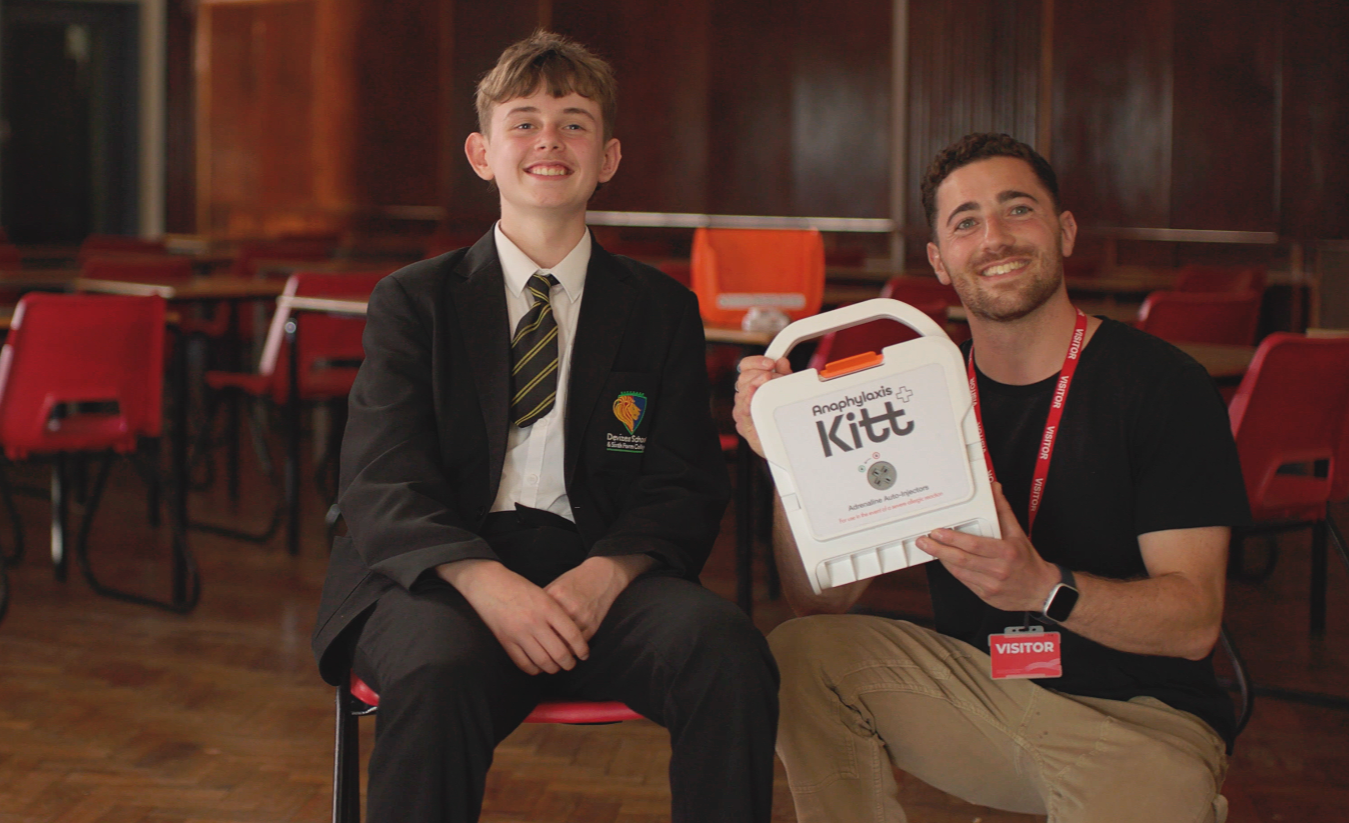
Many schools in the UK are already ahead of the curve, getting everything they need in place to be compliant before Benedict's Law comes into action. How prepared is your school?
This article summarises the Department for Education's statutory guidance, "Allergy Safety in Schools" (July 2026), issued under section 100 of the Children and Families Act 2014 as amended by section 34 of the Children's Wellbeing and Schools Act 2026. It is provided for general information and does not replace the full guidance, which schools have a statutory duty to have regard to, or individual clinical advice. Kitt Medical supplies wall-mounted anaphylaxis kits, CPD-accredited training and expiry tracking to help schools and qualifying businesses meet these requirements - get in touch if you'd like help auditing your current provision against Benedict's Law.
For the DfE's own direct content, see gov.uk/government/publications/allergy-safety-in-schools